Discover the scenic beauty and peaceful charm of the Himalayas on this journey through Darjeeling and Sikkim. Explore the vibrant city of Kolkata, the tea gardens and mountain views of Darjeeling, and the serene landscapes of Pelling, Gangtok, and Kalimpong.
This tour offers a perfect blend of Himalayan nature, monasteries, culture, and breathtaking mountain views.
Upon arrival, you will be met by our representative, followed by a transfer to your hotel. Evening at leisure.
Kolkata is the capital of the Indian state of West Bengal. According to the 2011 Indian census, it is the seventh most populous city; the city had a population of 4.5 million, while its suburban population brought the total to 14.1 million, making it the third most populous metropolitan area in India. Kolkata Megalopolis is the area surrounding the metropolis of Kolkata with additional residents. Situated on the east bank of the Hooghly River, approximately 80 kilometers west of the Bangladesh border, it is the main commercial, cultural, and educational center of eastern India, while the Port of Kolkata is India’s oldest operating port and only major river port. Nicknamed the “City of Joy,” the city is widely regarded as India’s “cultural capital,” and as of 2019, six Nobel laureates have been associated with it. Recent estimates of the Kolkata Metropolitan Area’s economy range from $60 billion to $150 billion (GDP adjusted for purchasing power parity), making it the third-most productive metropolis in India, after Mumbai and Delhi.
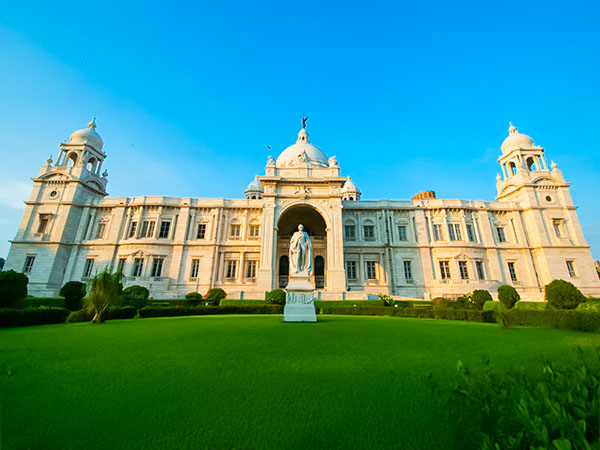
Breakfast at the hotel this morning. A full city tour will follow at the agreed-upon time, including a visit to the flower market, the Dakshineswar Temple, the Belur Math, the Victoria Memorial, and Mother Teresa’s house. The Victoria Memorial is a large marble building in Kolkata (formerly Calcutta), West Bengal, India, built between 1906 and 1921. It is dedicated to the memory of Queen Victoria (1819–1901) and is now a museum and tourist destination under the auspices of the Ministry of Culture. The memorial is located on the Maidan (grounds) on the banks of the Hooghly River, near Jawaharlal Nehru Road. In January 1901, upon the death of Queen Victoria, George Curzon, 1st Marquess Curzon of Kedleston and Viceroy of India, proposed the erection of a suitable memorial. He proposed the construction of a grand building with a museum and gardens. Curzon said: “Let us therefore have a building, stately, spacious, monumental, and grand, to which every newcomer to Calcutta will turn, to which all inhabitants, European and Native, will come, where all classes may experience the lessons of history, and see the wonders of the past revived.” The Prince of Wales, later King George V, laid the foundation stone on January 4, 1906, and it was formally opened to the public in 1921.
After breakfast at the hotel, transfer to Kolkata airport for the flight to Bagdogra. Upon arrival, you will be met by our representative, followed by a transfer to Darjeeling.
Darjeeling – High in the Himalayas, at an altitude of 2,134m, Dorje Ling, or the place of the Thunderbolt, offers breathtaking views, including the snow-capped peaks of Kanchendzonga towering high above. Often referred to as the ‘Queen of The hills remain alluring with its small waterfalls, tiny villages, and narrow-gauge railway. Surrounded by world-famous tea gardens and snow-capped mountains, Darjeeling remains one of the most exotic destinations. Graeme Westlake, in his book “The Hill Stations of India,” refers to Darjeeling as a view that is unparalleled anywhere on earth.
After breakfast, take the “Toy Train” ride to Ghoom, where you will visit Ghoom Monastery. Return by Innova (subject to train operation and seat availability).
Toy Train: The spectacular landscape unfolds as the 2-meter-high Darjeeling Himalayan Railway, opened in 1881, travels crisscrossing the track at approximately 10 mph. Its small four-wheeled locomotives (some over 100 years old) are a living legend. Experience the sounds, smells, and romance of a bygone era. MR. It is a masterpiece of engineering and technology dating back to 1881. It is of social and cultural importance. It is beautiful and has excellent universal appeal.
Ghoom Monastery: Built in 1875, this is the oldest monastery in the area and features the 15-foot-high image of Mythical Buddha.
In the afternoon, continue on a city tour.
Himalayan Mountaineering Institute/Padamja Naidu Himalayan Zoological Park (both closed on Thursdays): The Himalayan Mountaineering Institute was established in Darjeeling when Tenzing Norgay climbed Everest to provide training for mountaineering and other adventure sports. They were involved in mountaineering. At this institute, you can see the equipment used by Tenzing Norgay. In the Himalayan Zoological Park, you can see snow leopards, Tibetan wolves, Tibetan bison, Himalayan black bears, and many species of birds.
Tibetan Self-Help Centers or Refugee Center (closed on Sundays): This institute is run by Tibetan refugees to preserve their handicrafts, and you can see how Tibetan carpets, leatherwork, paintings, and hot carvings are made.
Overnight stay at a hotel.
Early in the morning, visit Tiger Hill for the most beautiful view.
Tiger Hill: It is 13 km from Darjeeling, and you can see the sunrise and the Himalayan Ranges such as Kanchandzonga, Mount Everest, etc. Just before sunrise, you can see the horizon change color, and the entire Himalayan range turns golden.
Afterward, return to the hotel for breakfast.
After breakfast, you will visit the Happy Tea Garden.
Happy Valley Tea Estate: This is the second oldest tea garden in Darjeeling (after the Steinthal Tea Estate, founded in 1852). At an altitude of 2,100 meters, it is also one of the highest tea factories in the world. David Wilson, an Englishman, named the Wilson Tea Estate and began cultivating tea. In 1903, the estate was acquired by the Indian Tarapada Banerjee. In 1929, Banerjee purchased the nearby Windsor Tea Estate and merged the two estates under the name Happy Valley Tea Estate. G.C. Banerjee was the next owner of Happy Valley Tea Estate. He lived there for a time with his wife Annapurna Devi and three daughters (Nonimukhi, Monmaya, and Savitri). Annapurna Devi was related to the Ganguly family of Khandwa. Her maternal uncle was Kunjalal Bihari, the father of the famous Gangulys, a young prolific writer in LA, and the great-granddaughter of the late Monmaya Debi. In March 2007, the estate was purchased by SK Bansal of the Ambootia Tea Group, who established a new factory on the premises, simultaneously modernizing the facility and transitioning to organic farming.
Finally, the estate reopened to the public in 2008, with the original factory converted into a working museum.
From mid-November to March, there is no harvest or production at the factory; visitors are only allowed to visit the tea plantation during this period. During the festival season, particularly Durga Puja/Diwali, the tea garden remains closed for 7-8 days.
You have a free afternoon.
After breakfast, you will depart for Pelling.
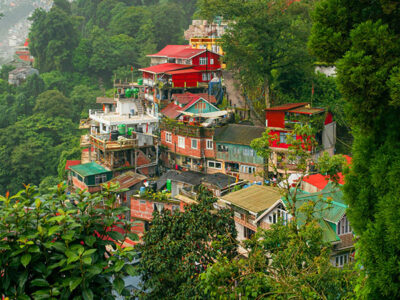
Pelling is a small town in the state of Sikkim, in the West Sikkim region. It’s a relaxing place and attracts many travelers from various parts of the country. Pelling is located near the foothills of Kanchenjunga, offering stunning views of the mountain. There are numerous scenic spots to visit in the area. The main attractions are the monasteries scattered throughout the countryside.
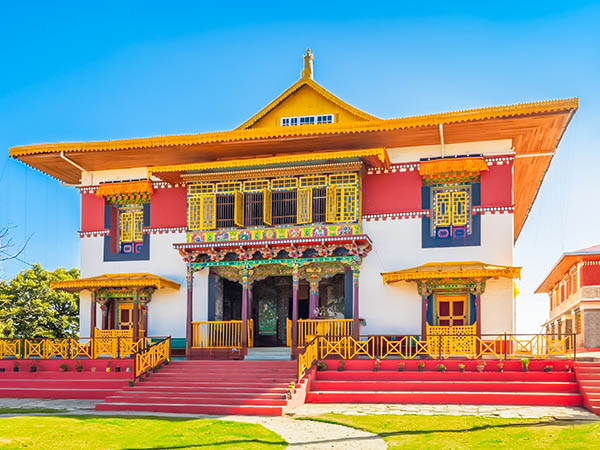
In the afternoon, visit Pemayangtse Monastery and Rabdanste Ruins.
Pemayangtse Monastery: 2.5 km from Pelling and situated at an altitude of 2085m. This perfect, sublime lotus, perched on a wooded hilltop, offers the most sublime view of Khangchendzong. Built in the late 17th century, it is one of the oldest and most important monasteries of the Nyingmapa order of Buddhism in Sikkim. To this day, only the monks of this monastery enjoy the title of “Tasang,” or pure monk. The monastery’s importance grew over time, reaching its peak when only monks from this monastery could anoint the country’s reigning sovereign with holy water. Pemayangtse Monastery follows the Mindroling tradition, along with the lineage of Lhatsun Chenpo.
Mindroling Monastery was founded by Minling Terchen Gyurme-Dorje, whose famous daughter, Jetsun Migyur Paldon, lived near Pemayangtse and taught there during her exile. Her stone throne can still be seen in this monastery, which has 108 monks. The monastery’s main attraction is the wooden replica of Zangdog Palri, the heavenly abode of Guru Padmasambhava, built by Serdup Lhundrup Dorje Rinpoche in 1971. The annual chaam (monk dance) is held here on the 28th and 29th days of the 12th month of the Tibetan lunar calendar.
Rabdentse: The second capital of Sikkim. The ruins of Rabdentse are definitely worth a visit. The winding pass through the forest takes you to small ruins of the former town and finally to the ruins of the palace with a chorten (stupa) nearby.
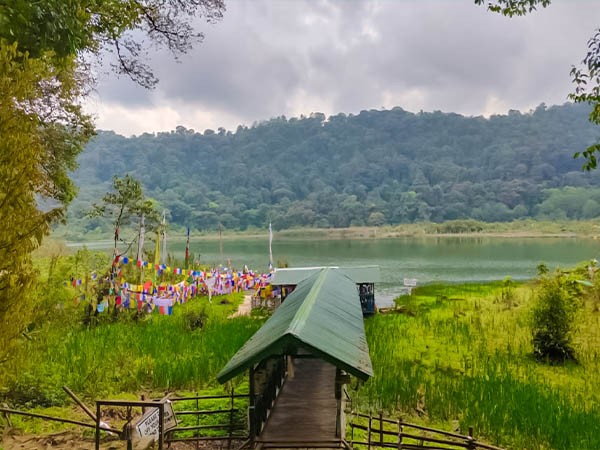
After breakfast, you will visit Khecheopalri Lake, Rimbi Falls, and Darap Village.
Khecheopalri Lake: Khecheopalri Lake is considered by both Buddhists and Hindus as one of the Sacred lakes of Sikkim. The lake remains hidden in the forest. It is believed that birds don’t even leave a single leaf floating on the lake’s surface. There is a motorable road from Pemayangtse to the lake area.
The Rimbi Waterfalls: This is one of Sikkim’s tourist attractions, located about 12 km from Pelling and about 5 km from Darap village, another Sikkim attraction. This waterfall can be seen year-round and is even more beautiful during the rainy season. The waterfall flows into the Rimbi River and is known for recreational activities such as fishing. Karachen Powerhouse is the oldest in western Sikkim. Built in the early 1970s by the reign of the last king, it supplied water to all the surrounding villages during that period.
Darap Cherry Village: This is one of the few undiscovered places where travelers seeking a taste of rural life can escape the crowded tourist spots. The word Darap comes from the limbo word “Tan-lop,” which literally means plain or even land. It is located just 8 km from Pelling on the way to Khecheopelri and Yuksam. The area is mainly inhabited by the Limboo community and other small communities such as the Bhutias, Chettris, Tamangs, Rais, Gurungs, and Lepchas. The landscape is gently undulating, unlike other locations in western Sikkim. Due to its proximity to Pelling, Darap is now a potential destination for village tourism.
After breakfast, drive to Gangtok via Buddha Park near Ravangla.
The Buddha Park of Ravangla, also known as Tathagata Tsal, is located near Rabong (Ravangla) in the South Sikkim district, Sikkim, India. It was built between 2006 and 2013 and features a 41-meter-high statue of the Buddha as its centerpiece. Nearby is also Relang Monastery, an important monastery in Tibetan Buddhism. The statue was consecrated by the 14th Dalai Lama on March 25, 2013, and is located on the Himalayan Buddhist Circuit. The Buddha statue commemorates the 2,550th anniversary of the birth of Gautama Buddha. This statue was built and installed in this location through the joint efforts of the Sikkim government and its people. The park’s Buddhist Circuit was built here as part of a state government project to promote pilgrimage and tourism in the region.
The rest of the day is at leisure.
Overnight stay at a hotel.
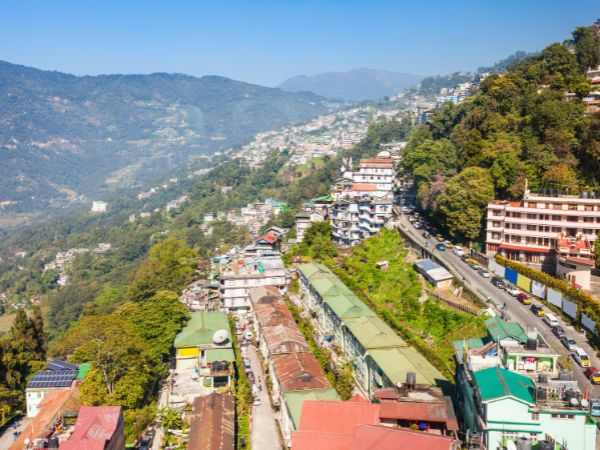
After breakfast, visit the main sights in Gangtok.
Rumtek Monastery, Tibetology (closed on Saturdays, Sundays, and school holidays) & Do Drul Chroten, Enchy Monastery, Cottage Industry, also known as the Directorate of Handloom and Handicrafts (closed on Saturdays, Sundays, and school holidays)
Rumtek Monastery: 24 km from Gangtok is the awe-inspiring Rumtek Monastery, the world center for the Dharmachakra and the seat of His Holiness the Gyalwa Karmapa, head of the Kagyupa order of Tibetan Buddhism. Behind the main monastery is the ornately decorated Karmae Nalanda Institute for Buddhist Studies, which attracts students from all over the world. Opposite the entrance to the institute is a small hall with a magnificent, bejeweled chorten and the golden stupa containing the ashes of the relics of His Holiness the 16 Gyalwa Karmapa. Legend has it that after a long meditation, the first Larmapa was visited by ten thousand fairies who came to congratulate him, each giving him a lock of her hair. These were woven into a black hat, which was passed down and still resides in Rumtek Monastery. It is said that unless the wearer holds it (who, of course, can only be the Karmapa) or keeps it in a box, the hat will fly away.
The Do Drul Chorten: Built to commemorate the victory of good over evil, the Jhang Chub Chotren is built in memory of Thrukshik Rinpoche, a fervent devotee, great spiritualist, and exponent of Buddhism. Near the Chorten stand two gigantic statues of Lord Buddha and Guru Padmasambhava, also known as Guru Rimpoche, the patron saint of Sikkim.
Namgyal Institute of Tibetology: Nestled amid a serene environment of oak and birch trees, this unique organization, founded in 1958, is located. Built in a traditional style, the Namgyal Institute of Tibetology promotes research in Mahayana Buddhism and the language and traditions of Tibet.
It boasts one of the world’s largest collections of rare books and manuscripts on Mahayana Buddhism. The institute also operates a retail outlet where related books and commercially produced religious art and crafts from Tibet can be purchased.
The Enchey Monastery: Nestled on a ridge above Gangtok, the Enchey Monastery offers spectacular views of the city. Gangtok. This monastery, built in 1910 on the site of the hermitage of the great tactical saint, Lama Drutob Karpo, who was known for his levitation skills, houses the monks of the Nyingmapa order of Tibetan Buddhism.
Directorate of Handicrafts and Handicrafts – This directorate was established to promote traditional Sikkimese arts and crafts. Beautifully carved friezes, intricate babu work, along with exquisite handwoven carpets and handlooms are on display here. Visitors can not only purchase these items but also watch the artisans at work. A favorite item here is the choktse, a wooden table with carved panels that folds into a portable package.
After breakfast, you will depart for an excursion to Tsomgo Lake.
Tsomgo Lake: 35km from Gangtok, at an altitude of 12,400 feet, lies the beautiful Tsomgo Lake, which freezes over in winter. The lake draws its water from the melting snow of the surrounding mountains. Legend has it that lamas could predict the future by studying the color of the lake’s water. Fishing is strictly prohibited, and everyone is requested not to pollute the lake’s surroundings to preserve its sanctity. Optional yak ride for a fee.
The rest of the day is free.
After breakfast, you will go on an excursion to Phodong Monastery and back.
Phodong Monastery: 38km from Gangtok. This monastery was built by the Chogyal Gyurmed Namgyal sometime in the first quarter of the eighteenth century in Phodong in North Sikkim. It belongs to the Kagyupa sect and is said to be the first Kagyupa monastery established in Sikkim. It is known for its exquisitely delicate murals and frescoes. The original monastery has been rebuilt and is now one of the most beautiful monasteries in Sikkim. It retains the ancient murals and has approximately 260 monks. Like Ralong and Rumtek, the main annual festival is held on the 28th and 29th days of the tenth month of the Tibetan calendar – on this day the religious dances are performed.
The rest of the day is at your leisure.
After breakfast, you will depart for Kalimpong.
Kalimpong: At an altitude of 1250m, Kalimpong is ideal for a pleasant, relaxing outing. The mild weather has made Kalimpong famous for its orchids and gladioli. Until the early 18th century, the Kalimpong region was part of the domain of the Raja of Sikkim. At the beginning of the 18th century, the Bhutanese king took over. In 1865, after the Anglo-Bhutan War, it was annexed to Darjeeling. Scottish missionaries arrived here in the late 1800s. The town flourished as a wool trading center with Tibet until 1950. Today, it is a tranquil hilltop resort and a haven for retirees.
Afternoon city tour of Kalimpong.
Mangal Dham: Mangal Dham is one of the most important religious centers in the beautiful hill station of Kalimpong. The place was built in memory of Guruji Shir Mangaldasji Maharaj, who arrived in Kalimpong in 1940 and made it his home.
He built several orphanages, schools, and temples here to serve God and humanity. Spread over an area of approximately two hectares, the temple has a prayer hall on the top floor where the idol of Raj Shyamji is housed. So make sure you don’t miss these pure and pious places during your visit to Kalimpong.
Flower Farms: Kalimpong’s climate is ideal for growing flowers and plants. Kalimpong is famous for its nurseries that export exotic flowers such as amaryllis, lilies, anthuriums, roses, gerberas, dahlias, gladioli, as well as orchids and cacti.
Durpin Dara: Offers panoramic views of Kalimpong, the snow-capped mountains of West Sikkim, the Teesta River, and its valleys.
Zang Dog Palri Fo-Brang Monastery: This relatively new monastery in Durpin Dara offers an exclusive panoramic view of the city and its surroundings. The prayer hall in the monastery is decorated with murals, and there is a rare three-dimensional mandala above.
After breakfast, you will go on an excursion to Pedong Monastery. The distance is 24 km and takes approximately 1 hour.
Pedong Monastery: Pedong Monastery is one of the oldest monasteries in Kalimpong. It is located just one kilometer from the historic Bhutanese fort of Damsang and can be reached on foot in 10 minutes. It is a Buddhist monastery of Bhutanese origin, built around 1837.
After breakfast at the hotel, you will be transferred to Bagdogra airport for your flight to Kolkata. Upon arrival, you will be met by our representative and transferred to your hotel. Evening at Free time at leisure.

For Right Tour Request, Price Quotation, Itinerary Suggestions, Bookings
14 Nights / 15 Days
Delhi - Jaipur - Agra - Mathura - Haridwar - Rishikesh - Delhi