Discover the spiritual and cultural essence of North India on this 15-day journey. Explore the historic landmarks of Delhi, the royal grandeur of Jaipur, and the timeless beauty of the Taj Mahal in Agra. Visit the sacred town of Mathura, the birthplace of Lord Krishna, and experience the divine Ganga Aarti in Haridwar. Rejuvenate in Rishikesh, the Yoga Capital of the World, surrounded by the serene Himalayas. This tour perfectly blends heritage, spirituality, and iconic Indian experiences.
Tour Itinerary:
Day 1: Depart home country – Delhi
Board the flight to Delhi according to the flight schedule.
Day 2: Arrival Delhi
Upon arrival in Delhi, you will be warmly welcomed by one of our staff members and transferred to your hotel. (Standard check-in time is 2:00 PM. You may have to wait for your rooms.)
Overnight stay at hotel
Day 3: Delhi - Jaipur (265 km / 6-hour drive)
After breakfast, the journey to Jaipur will begin at the agreed-upon time.
This drive will give you a glimpse of the beautiful Rajasthan. Now you’ll understand why Jaipur is called “the pink city.” The city is entirely surrounded by pink stone walls.
Upon arrival in Jaipur, you will then transfer to your hotel.
The remainder of the day is at your leisure. Overnight stay in a hotel
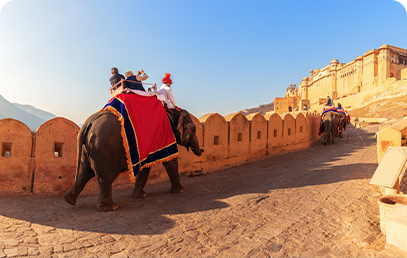
Today you will visit the Amber Fort for elephants, the Hawa Mahal, and the Sheez Mahal. If you would like to tour the fort from the inside, you must pay an entrance fee on site.
The Amber Fort—or Ajmer Fort, as it is also known—is one of the most popular buildings in India and is frequently visited. An average of 5,000 people visit it daily! The fort is built from a royal palace of light yellow and pink sandstone combined with marble. There are four main sections to the fort, each with its own exit. It served as the residence of the emperors of Ajmer, the capital of the Mughal Empire. The fort was built in 1592 by Raja Jai Singh, with additional sections later added by Sawai Jai Singh. The Amber Fort is located near the city of Jaipur. It was built on what was once a small village called Amba. Later, under the rule of the Kachwaha clan, led by Akbar the Great, this town became the capital of his empire, and construction of the palace began. Amba remained the capital until 1727, when Sawai Jai Sing moved the capital to Jaipur.
Overnight stay in hotel
Day 5: Jaipur – Fatehpur Sikri – Agra (245 km/6 km)
After breakfast, today’s journey continues to Agra, home to one of the Seven Wonders of the World. Along the way, you can visit Fatehpur Sikri, the capital of Emperor Akbar.
Fatehpur Sikri is a city and municipality in Agra district in the Indian state of Uttar Pradesh. It was the capital of the Mughal Empire from 1571 to 1585 and was built by the Mughal ruler Akbar the Great on a rocky terrain 37 km west of Agra in Uttar Pradesh, India. Because it was a ceremonial capital, the city was never fortified. Fatehpur Sikri is unique in its design and architecture. The city is considered to express Akbar’s personality and principles.
Overnight stay in hotel
Day 6: Agra
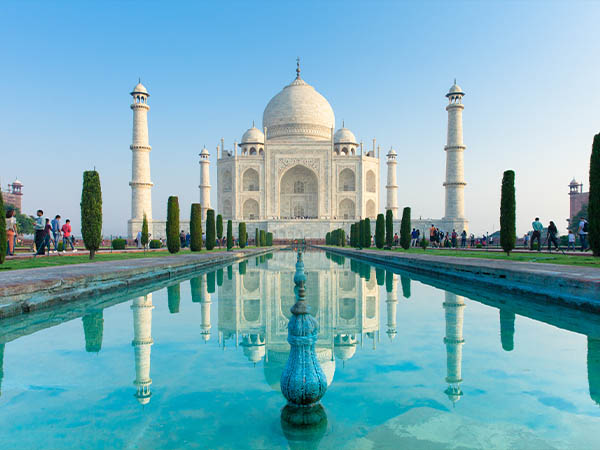
After a delicious breakfast, a half-day city tour awaits. Planning. You will visit, among other things, one of the Seven Wonders of the World: the Taj Mahal and Agra Fort.
The Taj Mahal is an impressive marble mausoleum in Agra (Uttar Pradesh). Shah Jahan, the fifth ruler of the Mughal Empire, commissioned the monument between 1632 and 1648 as the final resting place for his beloved wife, Mumtaz Mahal, who died in childbirth in 1631. After Shah Jahan’s death, the tomb was also placed there. The Taj Mahal stands not in the center of a garden, as is customary, but on a carefully considered platform on the banks of the Yamuna River in Agra, thus dominating the surrounding area. Four freestanding minarets occupy the corners of the platform, giving the structure a three-dimensional feel. The Taj Mahal is flanked by two identical buildings—the mosque and the guesthouse—constructed in contrasting red sandstone.
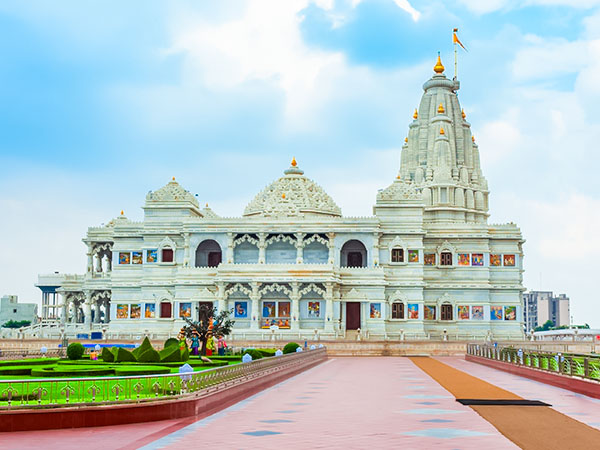
After breakfast, you will depart for Delhi. Along the way, you will also visit Mathura, the birthplace of Lord Krishna.
Overnight stay at hotel
Day 8: Delhi – Haridwar – Rishikesh
After breakfast, you will depart from Delhi for Rishikesh. En route, you will first stop in Haridwar. In Haridwar, you will first visit the Mansadevi Temple by cable car and then attend the Ganga Aarti.
Haridwar, formerly Gangadwara, is a city and municipality in Haridwar district in the Indian state of Uttarakhand. The city is located at the point where the Ganges River flows from the mountains into the valley and is one of the seven holiest places for Hindus.
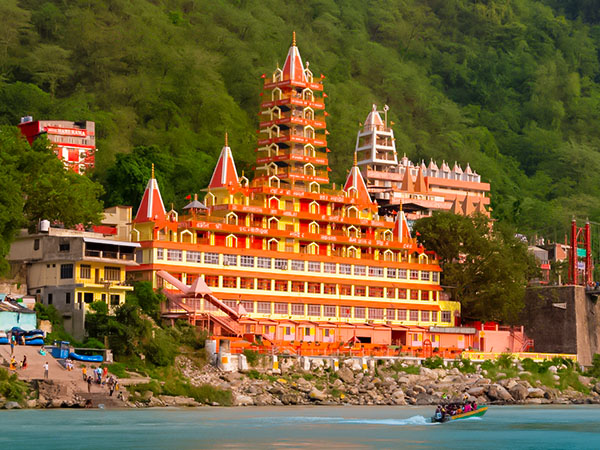
Rishikesh is a city and municipality in Dehradun district in the Indian state of Uttarakhand. It is located at the foothills of the Himalayas in Northern India. It is also known as the gateway to the Himalayas. Rishikesh is the city of yoga. of the world and known, among other things, for the Beatles’ visit to the Maharishi Mahes Yogi Ashram. The holy Ganges River flows through the city, just after leaving the Siwalik Mountains. Rishikesh is surrounded by mountains and is bisected by the expanding Ganga River. Yellow Located in the foothills of the Garhwal region, Rishikesh is “the place” for yogis and ashrams. It is the gateway to the upper Garhwal region and the starting point for pilgrimage routes to the four “dhams of Uttarakhand”—Badrinath, Kedarnath, Gangotri, and Yamunotri.
Overnight stay at hotel
Day 9: Rishikesh
Today in Rishikesh, you will visit Lachman Jhula, Geeta Ashram, Ram Jhula, and Triveni Ghat, among others. In the afternoon, you can explore the surrounding area on your own. Option: Rishikesh has many yoga ashrams. You can attend a yoga session if you wish.
Overnight stay at hotel
Day 10: Rishikesh – Delhi (235 km/5-6 hours drive)
After breakfast at the hotel, you will return to Delhi. Upon arrival in Delhi, transfer to the hotel. The rest of the day is free at your leisure. Overnight stay at hotel.
Day 11: Delhi
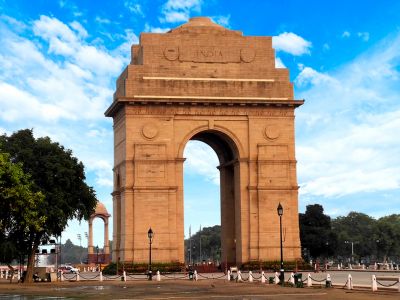
Today, an extensive city tour of Old and New Delhi is planned, led by an expert guide. You will be picked up at the agreed-upon time. During this city tour, you will see the Red Fort (Lal Kila), Raj Ghat, and enjoy a rickshaw ride. Later in the afternoon, you will visit the Birla Mandir, Lotus Temple, and India Gate. You will also pass the President’s House and Qutub Minar.
The Red Fort is a walled palace in Shahjahanabad, Delhi. Located on the Yamuna River, it is one of Delhi’s most famous landmarks and a UNESCO World Heritage Site. It is also where the Prime Minister of India delivers a speech every year on August 15th, the anniversary of India’s independence from Great Britain. The fort was built as a palace by the Mughal emperor Shah Jahan.
Qutub Minar is one of the finest examples of Islamic architecture in India. Located in Delhi, it is one of the city’s main tourist attractions. At 72.5 m high, the tower is the tallest stone tower in India. Construction began in 1193 under Qutb-ud-din Aybak, the first Muslim ruler of Delhi. The tower was not completed until 1368. The architectural differences are clearly visible. UNESCO declared the tower and its associated monuments a World Heritage Site in 1993.
Overnight stay at hotel
Day 12-13: Delhi
Today you can have a leisurely breakfast and a free day. You can plan your day as you please. [No transportation / no guide] Overnight stay at hotel
Day 14: Delhi
Today you can enjoy a leisurely breakfast and have a free day. You can plan your day as you please. [No transportation / no guide]
Overnight stay at hotel
Day 15: Departure Delhi (short layover)
Today you will be picked up at the agreed time for your flight back to home.
Contact Our Tour Planner
For Right Tour Request, Price Quotation, Itinerary Suggestions, Bookings