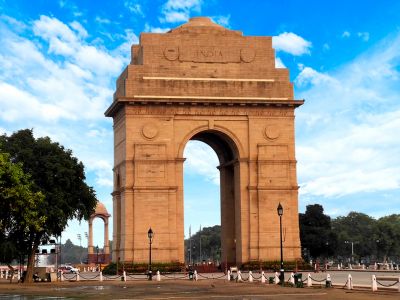
Today, a comprehensive city tour of Old and New Delhi is planned, led by an expert guide. You will be picked up at a prearranged time. During this city tour, you will visit the Red Fort (drive past), Raj Ghat, and also take a rickshaw ride. Later in the afternoon, you will visit the Birla Mandir, Lotus Temple, and India Gate. You will also see the President’s House, Parliament, and Qutub Minar along the way.
The Red Fort is a walled palace in Shahjahanabad, Delhi. Located on the Yamuna River, it is one of Delhi’s most famous landmarks and is a UNESCO World Heritage Site. It is also where the Prime Minister of India delivers a speech every August 15th, the day India gained independence from Great Britain.
The fort was built as a palace by the Mughal emperor Shah Jahan.
Qutub Minar is one of the finest examples of Islamic architecture in India. Located in the city of Delhi, it is one of the city’s main tourist attractions. At 72.5 meters high, it is the tallest stone tower in India. Construction began in 1193 under Qutb-ud-din Aybak, the first Muslim ruler of Delhi. The tower was not finally completed until 1368. The differences in architectural style are clearly visible. UNESCO declared the tower and its associated monuments a World Heritage Site in 1993.
Today, the picturesque town of Mandawa (Shekhavati district) is on the agenda. Shekhawati was once part of the Silk Road to China, where the inhabitants (the wealthy merchants) lavishly decorated their homes with religious, historical, cultural, and social themes.
Upon arrival in Mandawa, you will first check in at your hotel, and then enjoy the Shekhawati tour in the afternoon.
This small town is located in the heart of the Shekhawati region, which is brimming with beautiful havelis with intricate murals. This region had the highest density of millionaires, and it was customary for them to have a magnificent house (haveli = merchant’s house) built, decorated with numerous murals. Some of these paintings were very contemporary, and you’ll sometimes find stunning depictions alongside the familiar traditional paintings. It was also common for these wealthy merchants to build a school, a temple, a dharamshala (place of pilgrimage), and a well for the common good. You’ll also find a Shiva temple with a crystal lingam in Mandawa.
After breakfast, the journey continues to Bikaner. Upon arrival in Bikaner, you will be transferred to your hotel.
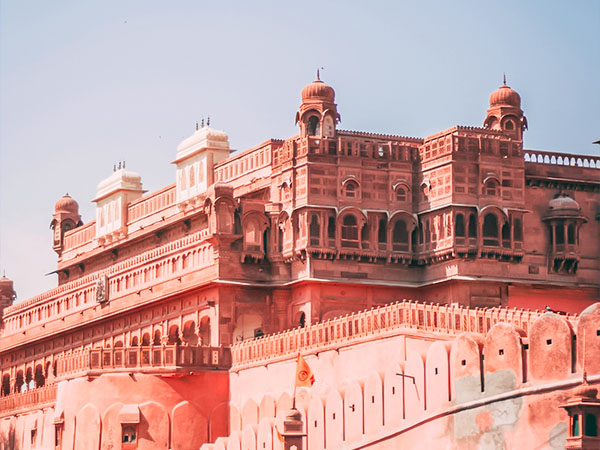
In the afternoon, you will enjoy a guided city tour. During the tour, you will visit Junagarh Fort, Lallgarh Palace, and the camel stables.
Bikaner is one of the most visited desert cities in the Indian state of Rajasthan. Rich in culture and tradition, Bikaner is a leading exponent of Rajasthani art and music. The people of Bikaner are renowned patrons of the fine arts. The Utsa school of art has its roots in Bikaner, Rajasthan. Bikaner’s folk music is renowned worldwide. The city’s fairs and festivals showcase the richness of Bikaner’s cultural and traditional heritage.
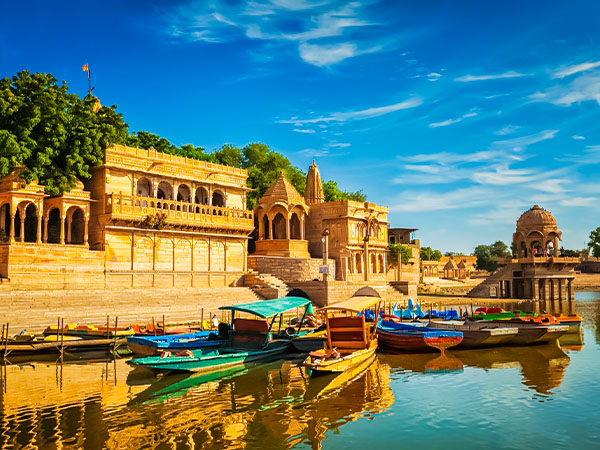
After breakfast, you will depart for a city tour or Jaisalmer. You’ll visit Jaisalmer Fort, Salim Singh Haveli, Patwon Haveli, Nathmal Haveli, and Gadisar Lake, among other attractions.
Nothing in India compares to Jaisalmer. While Jodhpur boasts one of India’s most spectacular forts, this Jaisalmer Fort, nestled in the remote desert, is a fairytale in itself. Like a Fata Morgana, the city rises from the desert. Strolling through the narrow streets of the fort and along the ramparts, you’ll feel like you’re in a tale from the Arabian Nights, transported back in time to the land of the Maharajas and Rajputs. This inspiring, romantic, and exciting city is also known with honor as the Golden City because of its honey-colored buildings and the sun shining brightly above. Finding your way around Jaisalmer is easy; you can reach everything on foot. The Jaisalmer district borders India and Pakistan to the north, west, and southwest.
In the evening, you will have the opportunity to ride a camel at Sam Sand Dunes. You will then be taken back to the hotel where you can plan your evening activities yourself.
After breakfast, you will be picked up and transferred to Jodhpur. Upon arrival in Jodhpur, you will check in at your hotel where you will spend the rest of the evening.
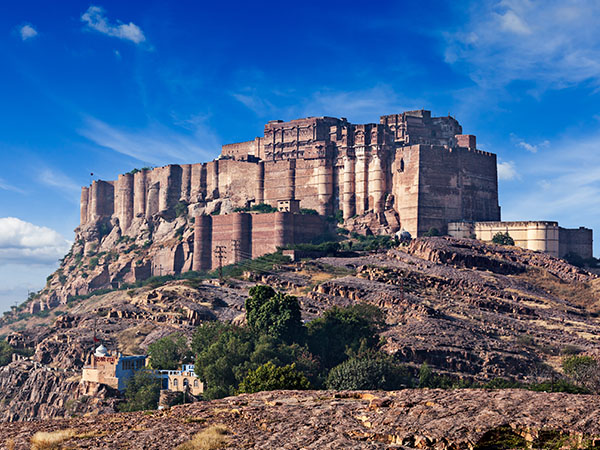
After breakfast, you will depart for a city tour of Jodhpur, visiting the Umaid Bhawan Museum, Mehrangarh Fort, and Jaswant Thada, among other places. (Umaid Bhawan Museum is closed on Mondays.)
Jodhpur is located in the central state of Rajasthan in northwest India. Formerly the capital of a princely state of the same name, Jodhpur is now a popular tourist attraction due to its many palaces, forts, and temples, and the surrounding captivating desert landscape. The city is nicknamed “Blue City” because of the indigo-colored walls of the houses in the old town and “Sunny City” because of its sunny desert climate. The old town is completely surrounded by a 16th-century city wall. Handicrafts are now the city’s most important industrial sector. The export of furniture is very important; approximately 200,000 people find direct or indirect employment in this industry.
After breakfast, you will depart for Udaipur. En route, you will visit Ranakpur, known for its 500-year-old Jain temples. Upon arrival, you will check into your hotel where you will stay for the rest of the evening.
You can book your guide here.
Ranakpur – is an enchanting place located between the cities of Jodhpur and Udaipur. Located in the Pali district of Rajasthan, Ranakpur is known for its spectacular array of Jain temples. Ranakpur is a must-see destination for any pilgrim.
This charming village takes its name from Rana Kumbha, a magnificently carved 15th-century Jain temple in amber stone. Ranakpur is one of the five holiest Jain sites and boasts exceptional natural beauty. Dharna Sah, a Jain businessman, approached Rana Kumbha when he envisioned his grand temple and requested a portion of the land for its construction. These magnificent Jain temples were built during the reign of the open-minded and gifted monarch Rana Kumbha in the 15th century. The basement of the complex encompasses 48,000 square meters, twenty-four pillared halls, and domes supported by more than 400 columns. There are 1,444 columns, each intricately carved with a different appearance. (These temples are open daily for non-Jains from 12:00 PM to 4:00 PM.)
After breakfast at your hotel, you will depart today for a guided city tour of Udaipur. You will visit the City Palace, Saheliyon Ki Bari, and the Jagdish Temple, among other attractions.
Udaipur was founded in 1568 by Maharana (King) Udai Singh II, ruler of the Mewar Empire in southern Rajasthan. Shortly before, he had escaped capture during the conquest of Chittorgarh. Udaipur became the new capital of the Mewar Kingdom. Udaipur is also known as the crown jewel of the Indian region of Rajasthan. It is immediately clear why Udaipur has become one of the country’s most popular tourist destinations, given the rolling Aravalli Hills that surround the city and its location on the picturesque Lake Pichhola. The city has served as the backdrop for several Hollywood films, such as the 1983 James Bond film Octopussy. This has further contributed to the city’s appeal.
In the afternoon, you will have the opportunity to take a boat trip on Lake Pichola.
After breakfast, you will depart for Pushkar today. Upon arrival in Pushkar, you will check in at your hotel. In the afternoon, you will embark on a city tour of Pushkar, including a visit to the Brahma Temple and the ghats of Pushkar Lake. [Unguided]
Pushkar is a city in the Indian state of Rajasthan, 14 kilometers from Ajmer, in the Ajmer district. Pushkar has a population of 14,789. The city is considered a holy city by Hindus and is an important pilgrimage site. The 12-day Pushkar Camel Festival takes place there annually. The only temple in India dedicated to Brahma, the 14th-century Jagatpita Temple, is located in this city. At the entrance stands a goose, Brahma’s personal animal. It is said that he himself chose this spot for a temple.
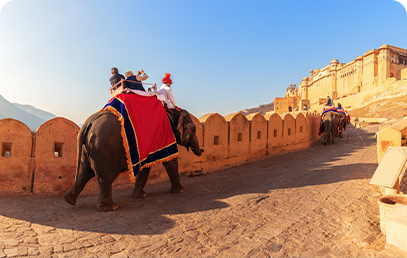
Today you will visit Amber Fort by elephant, Hawa Mahal, and Sheez Mahal. (The elephant ride is paid for by us, but you must pay the entrance fee to enter Amber Fort yourself.)
Amber Fort—or Ajmer Fort, as it is also known—is one of the most popular buildings in India and is very popular. An average of 5,000 people visit daily! The fort is built from a royal palace of light yellow and pink sandstone combined with marble. There are four main sections of the fort, each with its own courtyard. It served as the residence of the emperors of Ajmer, the capital of the Mughal Empire. The fort was built in 1592 by Raja Jai Singh I, with later additions by Sawai Jai Singh.
Amber Fort is located near the city of Jaipur. It was built in what was once a small village called Amba. Later, under the rule of the Kachwaha clan, led by Akbar the Great, this town became the capital of his empire, and construction of the palace began. Amba remained the capital until 1727, when Sawai Jai Singh moved the capital to Jaipur.
For Right Tour Request, Price Quotation, Itinerary Suggestions, Bookings
14 Nights / 15 Days
Delhi - Jaipur - Agra - Mathura - Haridwar - Rishikesh - Delhi