After collecting your luggage from the belt, walk to the exit (arrivals hall), where our colleague will be waiting for you. You will receive a warm welcome and be taken to the hotel.
Delhi – Officially, the National Capital Territory of Delhi is a city and a union territory of India. It is bordered by Haryana on three sides and Uttar Pradesh to the east. It is the most extensive city in India—approximately 1,484 square kilometers (573 square miles). It has a population of approximately 25 million, making it the second most populous city after Mumbai, the most densely populated urban agglomeration in India, and the third-largest urban area in the world. Delhi’s urban sprawl has seen it expand beyond the NCT to encompass cities in neighboring states. At its peak, it had a population of approximately 25 million as of 2014. According to data released by Oxford Economics, the Delhi NCR urban agglomeration has replaced the Mumbai Metropolitan Region as India’s economic capital. However, this agency did not compare figures specific to metropolitan Delhi and metropolitan Mumbai. Delhi is the second richest city after Mumbai in India, with a net worth of $450 billion. It is also home to 18 billionaires and 23,000 millionaires.
Overnight stay at a hotel
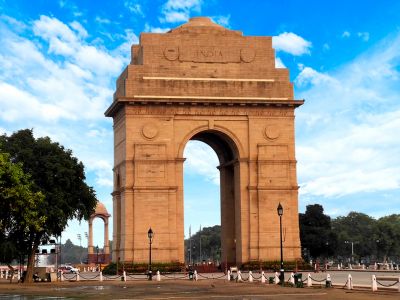
Today, you’ll enjoy a comprehensive city tour of Old and New Delhi with an expert guide. You will visit Lal Kila, Parliament Buildings, Birla Temple, Lotus Temple, India Gate, Raj Ghat, Chandni Chow, and more.
Red Fort – The Red Fort was the residence of the Mughal emperor for almost 200 years, until 1857. It is located in the center of Delhi and houses several museums. Besides housing the emperors and their households, it was the ceremonial and political center of the Mughal government and the setting for events that critically influenced the region.
The India Gate – (originally called the All India War Memorial) is a war memorial on the Rajpath, at the eastern edge of the “ceremonial axis” of New Delhi, India, formerly known as Kingsway. India Gate is a memorial to the 82,000 soldiers of the undivided Indian Army who died between 1914 and 1921 in the First World War, in France, Flanders, Mesopotamia, Persia, East Africa, Gallipoli, and elsewhere in the Near and Far East, and the Third Anglo-Afghan War. The gate inscribes the names of 13,300 servicemen, including some soldiers and officers from the United Kingdom. Although a war memorial, India Gate evokes the architectural style of a triumphal arch, such as the Arch of Constantine outside the Colosseum in Rome, and is often compared to the Arc de Triomphe in Paris and the Gateway of India in Mumbai.
Overnight stay at hotel
After breakfast at the hotel, transfer to Delhi airport in time to connect your flight to Kolkata. Upon arrival, you will be met and assisted by our representative, followed by transfer to your hotel. Evening free at leisure.
Kolkata is the capital of the Indian state of West Bengal. According to the 2011 Indian census, it is the seventh most populous city; the city had a population of 4.5 million, while its suburban population brought the total to 14.1 million, making it the third most populous metropolitan area in India. Kolkata Megalopolis is the area surrounding the metropolis of Kolkata with additional inhabitants. Situated on the east bank of the Hooghly River, approximately 80 kilometers west of the border with Bangladesh, it is the main commercial, cultural, and educational center of eastern India. Kolkata’s port is India’s oldest operating port and only major river port. Nicknamed the “City of Joy,” the city is widely regarded as India’s “cultural capital,” and as of 2019, six Nobel laureates have been associated with the city. Recent estimates of the Kolkata Metropolitan Area’s economy range from $60 billion to $150 billion (GDP adjusted for purchasing power parity), making it the third-most productive metropolis in India, after Mumbai and Delhi.
Overnight stay at hotel
Breakfast at the hotel this morning, followed by a full city tour of Kolkata, including a visit to the flower market, Dakshineswar Temple, Belur Math, the Victoria Memorial, and Mother Teresa’s house.
The Victoria Memorial is a large marble building in Kolkata (formerly Calcutta), West Bengal, India, built between 1906 and 1921. It is dedicated to the memory of Queen Victoria (1819–1901) and is now a museum. A tourist destination under the auspices of the Ministry of Culture, the monument is located on the Maidan (grounds) on the banks of the Hooghly River, near Jawaharlal Nehru Road. In January 1901, upon the death of Queen Victoria, George Curzon, 1st Marquess Curzon of Kedleston and Viceroy of India, proposed the erection of a suitable monument. He proposed the construction of a grand building with a museum and gardens. Curzon said: “Let us therefore have a building, stately, spacious, monumental, and grand, to which every newcomer to Calcutta will turn, to which all inhabitants, European and Native, will come, where all classes will learn the lessons of history and see the wonders of the past revived.” The Prince of Wales, later King George V, laid the foundation stone on January 4, 1906, and it was formally opened to the public in 1921.
Overnight stay at Hotel
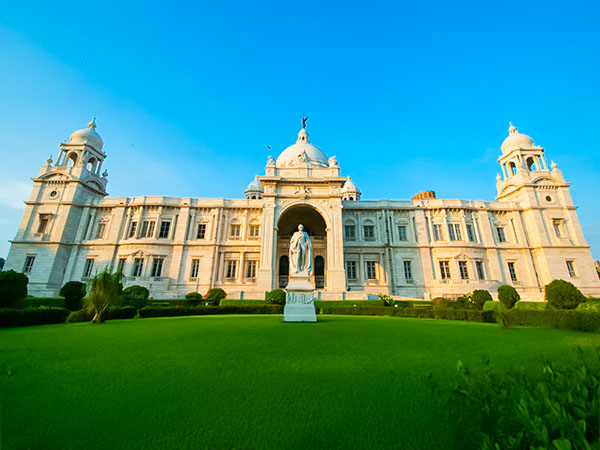
After breakfast at the hotel, transfer to Kolkata airport in time to connect the flight to Patna. Upon arrival, you will be met and assisted by our representative, followed by transfer to the hotel.
Patna is the capital of Bihar and the second largest metropolis in Eastern India. The journey of Patna through the ages, washed by the three sacred rivers Ganga, Sone, and Punpun, could well be the envy of any place that broods over his life chronicle. The city teems with a glorious past and settles into the vibrancy of a bustling and emerging metropolis. Legend has it that a sanctified Ganga watched with reverence as a holy Buddha blessed this place as a realm of great kings and their kingdoms. Belonging to the Blue Family of cities with a royal heritage, it is the region where some of India’s greatest emperors walked, and where some of India’s greatest saints chose to preach. Guru Gobind Singh, the 10th Sikh Guru, was born here.
Overnight at Hotel
After breakfast at the hotel, you will later travel to Golghar in Patna city. In the afternoon, you will continue on a day trip to Vaishali (self-guided). Later, you will drive back to Patna for an overnight stay.
Vaishali – is a city in Bihar, India, and is now an archaeological site. Site. It is part of the Tirhut division (Tirhut). It was the capital of the Licchavi, considered one of the first examples of a republic, in the Vajjian Confederacy (Vrijji) Mahajanapada, around the 6th century BCE. It was here in 599 BCE that the 24th Jain Tirthankara, Bhagwan Mahavira, was born and raised in Kundalagrama in the Vajjian republic, making it a pious and auspicious pilgrimage for Jains. Gautama Buddha also preached his last sermon before his death in c. 483 BCE. In 383 BCE, the second Buddhist council was convened here by King Kalasoka, making it an important place in both the Jain and Buddhist religions.
Overnight stay at a hotel
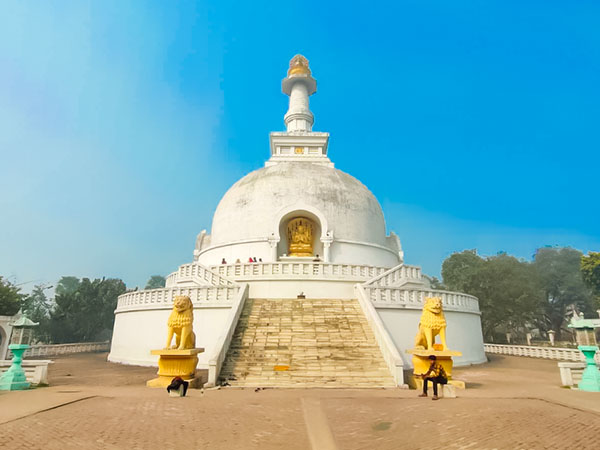
After breakfast, you will depart for Bodhgaya, visiting Gaya en route.
Gaya is a city of ancient historical and mythological significance. It is one of Bihar’s major tourist attractions. Gaya is the second-largest city in Bihar, with a population of 470,839, and is also the headquarters of Gaya District and Magadh Division. Gaya is located 100 kilometers (62 miles) south of Patna, the capital of Bihar. Situated on the banks of the Phalgu River (or Niranjana, as mentioned in the Ramayana), it is a place sacred to the Jain, Hindu, and Buddhist religions. It is surrounded by small rocky hills (Mangla-Gauri, Shringa-Sthan, Ram-Shila, and Brahmayoni) on three sides, and the river flows on the fourth (eastern) side.
In the afternoon, you will continue to Bodhgaya, where you will check in at your hotel upon arrival. Continue in the evening with a guided visit to the Mahabodhi Tree and Temple.
Bodh Gaya is a religious site and pilgrimage site associated with the Mahabodhi Temple complex in the Gaya district of the Indian state of Bihar. It is famous for being the place where Gautama Buddha is said to have attained enlightenment under what became known as the Bodhi Tree. For Buddhists, Bodh Gaya is the most important of the four major pilgrimage sites associated with the life of Gautama Buddha, the other three being Kushinagar, Lumbini, and Sarnath. In 2002, the Mahabodhi Temple, located in Bodh Gaya, became a UNESCO World Heritage Site.
Overnight at Hotel
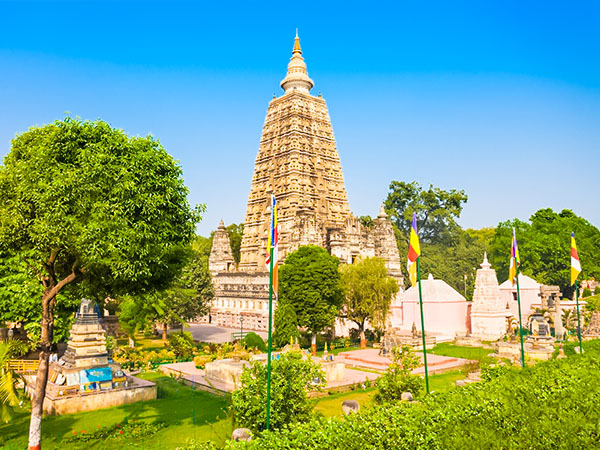
After breakfast at the hotel, drive to Varanasi. Check in at the hotel upon arrival. Evening free at leisure / visit local markets.
Overnight at Hotel
Early morning, take a guided boat trip to visit the sacred Ganges River, where thousands of devotees flock daily to the Boars of the Ganga River come to take a ritual dip, purify their souls, and worship in the many temples. Later, return to the hotel for breakfast, and after some time, the proceeds are set aside for the afternoon to explore this religious city with a guided visit to Sarnath, just outside Varanasi—it is as sacred to Buddhists as Varanasi is to Hindus. Here, you will witness the ruins of a once-thriving Buddhist monastery, then visit a beautiful museum with an excellent collection of Buddhist art and sculpture (closed on Fridays) and the Bharat Mata Temple. In the evening, witness a live Ganga aarti.
Overnight at Hotel
After breakfast at the hotel, drive to Prayagraj. Upon arrival, check in at the hotel. In the afternoon, you will visit Sangam (the confluence of the three rivers: Ganga, Yamuna, and Saraswati).
Prayagraj – According to Hindu mythology, Lord Brahma, the creator god of the Trinity, chose a piece of land on earth for the “Prakrishta Yagna,” where the three rivers—the Ganga, the Yamuna, and the mythical Saraswati—would flow into a silent confluence. This land, blessed by the gods, was named “Prayag” or “Allahabad,” as it is known today. It is one of India’s holiest pilgrimage centers.
Overnight stay at hotel
After breakfast at the hotel, drive to Ayodhya. Upon arrival, check in at the hotel. In the evening, continue to the Ram Janmabhoomi Temple.
Ayodhya, also known as Saketa, is an ancient city in India, believed to be the birthplace of Rama and the setting for the epic Ramayana. It borders the city of Faizabad in the central region of the Indian state of Uttar Pradesh. Ayodhya was the capital of the ancient Kosala Kingdom. It has an average elevation of 93 meters (305 feet). Believed to be the birthplace of Rama, Ayodhya (Awadh) is considered one of the seven most important pilgrimage sites (Saptapuri) for Hindus.
Overnight stay at hotel
After breakfast at the hotel, drive to Lucknow. Upon arrival, check in at the hotel. The evening is at leisure.
Overnight stay at hotel
After breakfast at the hotel, continue on a half-day guided city tour of Lucknow, visiting the city’s most beautiful monument, Bara Imambara. Other attractions include the Rumi Darwaza, Chota Imambara, and the remains of the old British residence, including La Martinere, one of the first large European-style buildings in Lucknow.
Lucknow, the capital of Uttar Pradesh—one of the largest states in India—is situated on the banks of the Gomati River, a tributary of the Ganges. It is an enchanting city with a blend of graceful elegance, captivating charm, and unique culture—a legacy it inherits from more gracious times when the kingdom of Avadh (Oudh) saw the last great flourishing of a civilization that began with the Mughals.
Chota Imambara—also known as Imambara Hussainabad Mubarak—is an imposing monument in the city of Lucknow, Uttar Pradesh, India. Built as an imambara, or congregation hall, for Shiite Muslims by Muhammad Ali Shah, the third Nawab of Awadh, in 1838, it served as his own mausoleum and that of his mother, who is buried next to him.
Overnight stay at hotel
After breakfast at the hotel, drive to Agra. Upon arrival, check in at the hotel. Evening free at leisure / visit local markets.
Overnight stay at hotel
Today, your journey continues to Agra, home to one of the Seven Wonders of the World. In the afternoon, you will visit the Taj Mahal and Agra Fort. (Entrance fee is at your own expense.)
The Taj Mahal is an ivory-white marble mausoleum on the south bank of the Yamuna River in the Indian city of Agra. It was commissioned in 1632 by the Mughal emperor, Shah Jahan (reigned 1628–1658), to house the tomb of his favorite wife, Mumtaz Mahal. The tomb is the centerpiece of a 42-hectare complex, which includes a mosque and a guesthouse, and is set in formal gardens bordered on three sides by a crenellated wall.
The Agra Fort is a UNESCO World Heritage site in Agra, Uttar Pradesh, India. It is located approximately 2.5 km northwest of its more famous sister monument, the Taj Mahal. The fort can be more accurately described as a walled city. The current structure was built by the Mughals, although a fort had existed there since the 11th century. Agra Fort was originally a brick fort known as Badalgarh, held by Raja Badal Singh, a Hindu Sikarwar Rajput king (c. 1475). It was first mentioned in 1080 AD when a Ghaznavide force captured it. Sikandar Lodi (1488-1517) was the first Sultan of Delhi to move to Agra and in the fort.
Overnight stay at hotel
After breakfast, you will depart for Delhi. On the way, you will also visit Mathura, the birthplace of Sri Krishna.
Overnight stay at hotel
Today you can enjoy a delicious breakfast at your hotel and have the entire day at leisure. You can plan your day as you please and visit local markets. [No transportation/guide]
Overnight stay at hotel

For Right Tour Request, Price Quotation, Itinerary Suggestions, Bookings
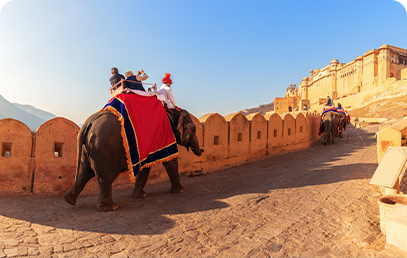
14 Nights / 15 Days
Delhi - Jaipur - Agra - Mathura - Haridwar - Rishikesh - Delhi